

Runners, flat shoes or bare foot – what should I wear to lift weights?
- Written by Hunter Bennett, Lecturer in Exercise Science, Adelaide University
If you go to the gym often, you might have been told you shouldn’t lift weights in runners.
The common belief is it is bad for your performance and can lead to injuries.
But is this really the case? Let’s unpack the science.
What your feet are doing when you lift
Your feet are key to exercising safely and effectively.
When you walk and run, they act like a springs and help propel you forward with each step. Your feet also help you maintain balance by supporting your weight.
When you lift any amount of weight (for example, doing compound exercises such as squats) your feet are working hard to keep you stable – even if you’re not thinking much about them.
Researchers have also suggested having a stable foot helps you push more efficiently into the ground. This may increase the amount of weight you can safely lift.
But what you wear on your feet may also contribute to this.
Can’t I just wear runners?
Unsurprisingly, given their name, running shoes are designed specifically to improve your performance and protect your feet while running.
They generally have a raised heel, a thick, cushioned sole to absorb shock, and a “rocker” shape that helps you roll from your heel to your toe. These features help reduce the impact of running on your body.
But in the gym, this cushioned sole may absorb the force you create when lifting weights, making you feel less stable, strong, and powerful. This is likely why some people may say you shouldn’t lift weights in running shoes.
Some people may be concerned this can lead to weightlifting injuries.
One 2016 study found wearing running shoes for exercises like squats can change how your ankle and knee joints move. But there is no peer-reviewed evidence linking these changes to injury.
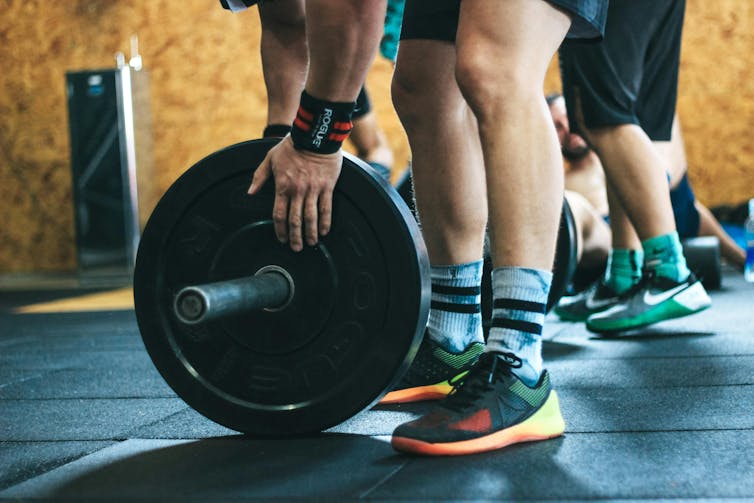
What are my other options?
Aside from running shoes, there are three other shoe types people generally wear while lifting weights: minimalist (sometimes called “barefoot”), flat or weightlifting shoes.
Minimalist shoes are designed to simulate being barefoot. They have thin soles with almost no cushioning, and aim to let the foot interact with the ground as if you were not wearing shoes at all. Flat sneakers designed for casual wear, such as Vans or Converse, also have thin soles without cushioning.
As a result, these types of shoes may be a good choice for lifting weights because they will be more stable than runners.
In contrast, weightlifting shoes are designed to improve how you perform in the gym.
They typically have a raised heel and a solid, stiff sole without any give, often made of wood or hard plastic. This helps you stay stable at the bottom of a deep squat, which is particuarly useful for movements such as squats, cleans and snatches.
But how do these different shoes stack up?
Studies looking at the impact of footwear on gym performance is largely limited to the squat and deadlift, probably because these are focused on leg strength.
One study from 2020 comparing running and weightlifting shoes found the latter helped people squat with a more upright torso and more flexibility in their knees.
This can take stress off the lower back and make your leg muscles work harder, which is the main purpose of the exercise.
Similarly, research from 2016 showed people wearing weightlifting shoes felt more stable when squatting. This suggests they may be a better option for that specific exercise.
A 2018 study focused on people performing deadlifts. It found running shoes reduced how quickly people could push force into the ground compared to when they wore only socks. This may suggest that they were more stable without running shoes.
However, this difference was small and has not been consistently replicated in other studies.
So what shoes should I wear?
That ultimately depends on your personal goals and situation.
Weightlifting shoes might be your best bet when doing squats. But if you mainly stick to deadlifts, flat shoes may slightly boost your performance. That is if your goal is to lift as much weight as possible.
However, if you are an Olympic weightlifter who needs to get into a deep squat position for competition, weightlifting shoes are the ideal option.
For everyone else, what shoes you wear may not matter as much. So wear whatever is most comfortable and keep lifting those weights.
Authors: Hunter Bennett, Lecturer in Exercise Science, Adelaide University


 Hashtag.net.au
