

death-haunted masterpiece The Blind Owl shadows the decline of modern Iran
- Written by Hossein Asgari, Postdoctoral Research Fellow, Adelaide University
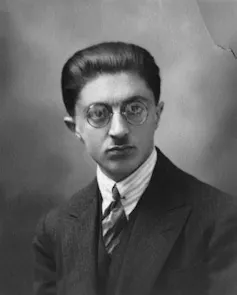
Sadeq Hedayat (1903-1951) abandoned his training in dentistry and, later, engineering in France and Belgium, to study old Persian and Iranian mythology. He would become one of the first modernist fiction writers in Iran. He published stories, essays and plays, but The Blind Owl, a short enigmatic novel, has been celebrated as his masterpiece.
Heyadat was a nationalist who lived during one of the most turbulent periods of modern Iranian history. Major events in his lifetime included the Constitutional Revolution (1905-1911), which aimed to limit royal power and modernise the state; the rise of the moderniser and authoritarian Reza Shah (1925-1941); and the second world war, when Iran was occupied by British and Soviet forces (1941-1945).
Hedayat seemed burdened by Iran’s downfall from its glorious past and its decline into social inequality and political repression. He felt the tension between the nation’s transplanted modernity and its dogmatic traditions, which he mocked for being riddled with superstition and empty rituals.
The dire social and political landscape of his time contributed to the existential despair and pessimism that is prominent in his writing.
The Blind Owl unravels like a nightmare. It opens with one of the most famous lines in modern Persian literature: “There are wounds in life, that like leprosy, gnaw at the soul in solitude.”
The novel walks us through the hallucinations of a bedridden man who is plagued by paranoia and fear of death, and it culminates in a murder – or rather the lustful dream of a murder. Hedayat’s unnamed narrator is tired of the world and its people, whom he calls “scumbags”. He only writes for his “shadow”, afraid to die without getting to know himself.
The story starts with him speaking to his “shadow”. Through his confessions, we learn about his obsession with an “ether woman”, his sexual desires, the murders he commits, and his ambivalent attitude towards death. We also see him lust after his wife, who does not share his bed. He thinks she is unfaithful and pregnant with another man’s child.
Children of death
Like most literary masterpieces, The Blind Owl does not lend itself to one simple interpretation. But central to the story are the concepts of death, shame and attaining self-awareness. The latter is expressed in the author’s dialogues with his shadow, which evoke Carl Jung’s idea of shadows as the suppressed, unknown and guilt-ridden parts of our psyche.
The protagonist speaks to his shadow in an attempt to know himself, perhaps in an attempt to accept himself completely, something Jung described as “the most terrifying thing”.
At the end of The Blind Owl, the shadow on the wall morphs into an owl. In different cultures and at different times, an owl can have different meanings. It can be interpreted as a bad omen promising death and ruin, or as a symbol of wisdom.
In Hedayat’s story, the owl can be associated with both. The novel implies that it is only through understanding our dark side that true wisdom might be possible. Without truly understanding his mortality, Hedayat’s narrator cannot grasp the truth behind his life and his motives. As he says: “Only death never lies!”
As the title suggests, however, the owl is blind. This is more than an aesthetic move to make something ominous sound more forbidding. Would our shadow, the blind owl, gain sight as we come to terms with it, accept it, and by doing so accept ourselves completely?
“We are children of death,” the narrator writes. And like all children, we are, to a large extent, formed by our parents. Isn’t everything we do – creating art, acquiring knowledge, reproducing, even our futile attempts at collecting resources and controlling everything and everyone – driven by death, by our knowledge of death, and our fear of it?
The narrator’s psyche is haunted by death to such an extent that even a door left open looks like “the mouth of the dead”. Clouds hang over his head “yellow and deathly”. His bed is “colder and darker than a grave”.
Yet his attitude towards death is ambivalent. He calls death a “bitter truth”. Its fear does not leave him, but the thought of death comforts him, as he says: “Death … Death … Where are you?” It seems that fear of death is too much to bear, yet only death can end his unbearable fear and bring him peace.
Thanatos and Eros
The protagonist’s “true wish” to be “annihilated” brings to mind the Freudian concept of Thanatos, or the death drive. His desire to return to a state of non-existence is explicitly expressed:
The one thing that made me feel better was the annihilation after death. The thought of another life after death made me feel afraid and tired.
Thanatos, associated with aggression and repetition, dominates the novel. Time is always measured in units of two and four: two months and four days, or two years and four months. The narrator always has two qerans and one shahi (Iranian currencies used before the modern rial) in his pocket. The characters are also repetitions of each other, as if recycled, as if the world described in the novel is not capable of creating anyone new, so the same people reappear over and over.
Even the painful love he is experiencing, he comes to realise, is the same as the love experienced by another artist a thousand years ago.
According to Freud, life is a constant struggle between Thanatos and Eros, the life instinct. For Hedayat’s protagonist, Thanatos has become the dominant force, manifested in his self-destructive behaviour and his excessive use of opium and alcohol.
All his actions, even those usually driven by Eros, are tainted by death. His pen-case paintings are repetitive: a cypress tree, with an old man resembling an Indian yogi squatting underneath, and a girl in a long black dress (the ether woman) offering him a lili.
His love is obsessive, his desires are shameful, and his only physical intimacy with his wife ends in murder.
The ideal and the real
Shame follows the narrator throughout the story, linked to his sexual desires. The first time he kisses the woman who later becomes his wife, his future father-in-law walks past and his “repulsive ominous laughter” makes the narrator wish he was dead.
The exact same thing happens when he kisses his teenage brother-in-law, who reminds him of his wife. In a book full of strange moments, this might be one of the strangest and most unexpected. Is it a reflection of the lonely protagonist’s struggle with his sexual identity? Or another attempt to replace the unrealistic, unattainable love he seeks in the ether woman with a worldly love, similar to his failed love for his wife?
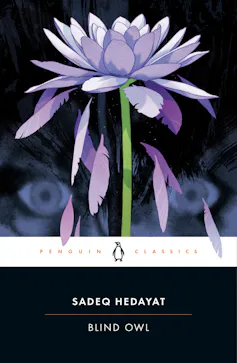

As a nationalist, Hedayat glorified ancient Iran and was highly critical of what he perceived as Iran’s social and political decay. In his satirical work Haji Aqa, he depicts Iranian politicians and leading figures as hypocritical, greedy, amoral and opportunistic.
Bearing this in mind, if we look at The Blind Owl from the perspective of Hedayat’s nationalism, it admits other possible interpretations.
Is the stagnant, nightmarish world of the novel a representation of how Hedayat saw his society? Is the love-hate relationship between the narrator and his wife a reflection of Hedayat’s feelings towards the country he loved, while being simultaneously embarrassed by its centuries-long decay?
Does the ether woman represent the Iran he wished for and his wife the real one? Is that why, after killing the ether woman, he buries the corpse in the ancient city of Rey, one of the oldest continuously inhabited cities in Iran? Is that why he sees his love for his wife as accompanied by filth and death?
Hedayat attempted suicide by throwing himself in the Seine while living in Paris in his twenties, but was rescued. The temptation of peace promised by death never completely left him. He took his own life at the age of 48.
Authors: Hossein Asgari, Postdoctoral Research Fellow, Adelaide University

 Hashtag.net.au


