

Geoffrey Robertson believes international law is failing us – but the solutions are unclear
- Written by Paul Taucher, Lecturer in History, Murdoch University
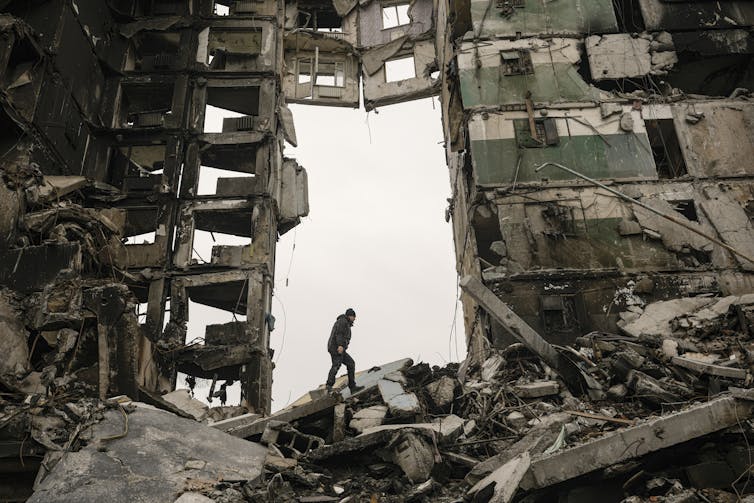
World of War Crimes: Eyeless in Gaza … and Beyond, the latest book by barrister and human rights advocate Geoffrey Robertson, quickly establishes that contemporary international laws against war crimes are completely ineffectual.
The ongoing violence in Ukraine, Gaza, Sudan, Myanmar, the Tigray region of Ethiopia, Kashmir and elsewhere is, initially, a compelling point in Robertson’s favour. So is the failure of courts, either international or domestic, to prosecute individuals, governments, militaries or corporations for the horrors of war.
No doubt, Robertson would also include US President Donald Trump’s order for the US military to kidnap Venezuelan President Nicolás Maduro as an example of the failure of international law.
Review: World of War Crimes: Eyeless in Gaza … and Beyond – Geoffrey Robertson (Penguin)
At the end of the second world war, a new international system was created. War criminals were prosecuted before national and international tribunals. The United Nations was formed to prevent wars and guide peaceful resolutions to potential conflicts. A host of new treaties to limit the horrors of war were signed.
How these systems failed and how to fix them are the central questions of Robertson’s book.
Robertson’s key reason for the failure of international law is relatively straightforward. The international order that emerged from WWII favoured the great powers of the US, the USSR/Russia, China, the UK and France. As permanent members of the UN Security Council, these countries have the right to veto any UN action.
Since the formation of the UN and the Security Council in 1945, these five countries have turned international law into a pointless exercise, designed not to end, or even limit, human suffering, but rather to allow them to wage war on their own terms. Militaries, politicians and government lawyers have twisted the inherent virtues of war law to justify or excuse practically every war crime, whether it be carpet bombing civilians, torture, summary execution or illegal detention.
As Robertson points out, excuses and justifications for what are clearly war crimes are apparent at the highest level. When Russia bombs a pizza restaurant in Ukraine, experts are conditioned to say it “may” be a war crime, rather than unequivocally condemn the action for what it is.
As a researcher who has engaged with contemporary war-crime reporting, this point hit home particularly clearly. There are many events that I regards as clear crimes. But the norms of legal analysis, as well as the spectres of defamation claims and accusations of partisanship (or worse), has made me more reserved than I would like and ought to be.
How did we get here?
Robertson’s book is split thematically into two parts. The first is a rough history of the laws and crimes of war. It examines the inception of the international community’s attempts to limit wars, acts of aggression, torture and the killing of civilians, as well as the problems of nuclear weapons and military courts.
From the outset, Robertson is clear that he has not written a legal text. There is no deep-dive into the existing laws of war. This is because the great powers and their allies have found ways to legally justify their crimes. The US, Russia and Israel have all expanded the right to self-defence to a farcical degree.
The killing of civilians through airstrikes and drones is now covered by the defence of proportionality. It is okay to bomb a hospital, according to the aggressor, because enemy military personnel were using it.
Government lawyers during former US President George W. Bush’s administration devised legal arguments that were transparently intended to provide cover for the torture of personnel who ought to have been protected as prisoners of war, reclassifying them as “unlawful combatants”.
Robertson is at his most compelling here. Rather than dealing with the legal arguments, he states clearly that these are abhorrent acts that should be labelled as crimes and subject to prosecution.
But his arguments and evidence can be less compelling, if not openly contradictory.
He claims, for example, that the 1925 Geneva Protocol, which prohibited the use of chemical weapons, was ineffective and the only thing that stopped Britain and Germany from using chemical weapons during WWII was the threat of reprisal. At the same time, he argues that nuclear weapons should be made illegal.
How a legal prohibition on nuclear weapons would work, when it apparently did not work for chemical weapons, is unclear.
Similarly, he claims that the US cynically “tweaked” the law relating to self-defence to invade Afghanistan in 2001, but was also entitled to invade and overthrow the Taliban because of demands for justice. While both claims can be true, there is no real explanation of why the law needed to be tweaked if the pursuit of justice permitted the invasion under international law.
What is to be done?
In the opening and closing sections, Robertson proposes ways to fix the deficiencies of international law he has identified.
The big fix involves liberal democracies joining together to respect human rights and prosecute those who breach the laws of war: an international community separate from the failures and weasel words of the United Nations. Countries that refuse to engage with this new human-rights regime would be ostracised and sanctioned by the wealthy and righteous.
This is an appealing notion, but Robertson’s proposal is not as clearly thought out as one would hope. At the forefront of this new liberal-democratic mission would be Britain, the Commonwealth and the European Union. Wilfully or not, Robertson glosses over the fact that these are the same parties that created, benefited from and went along with the system he is so displeased with.
France and the UK, in particular (but by no means exclusively), have committed heinous colonial crimes that they have not come to terms with.

Authors: Paul Taucher, Lecturer in History, Murdoch University


 Hashtag.net.au
