

Best evidence suggests most children’s flat feet will be fine
- Written by Angela Evans, Adjunct Senior Lecturer, La Trobe University
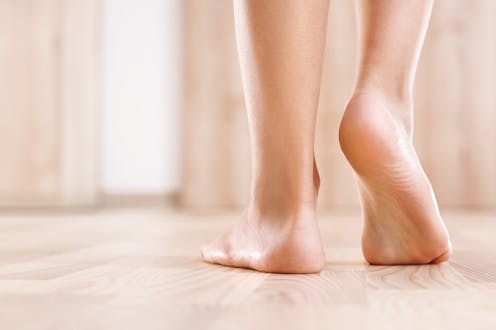
A recent article in The Conversation raised unnecessary alarm about children’s flat feet.
The article isn’t supported by the best evidence and may have worried parents.
The most recent evidence confirms it’s normal for young, healthy and active children to have flexible flat feet, and these flat feet will get less flat over time.
Flat feet require assessment if they hurt, look different left and right, or if they occur in older children, with few requiring treatment.
Children’s flat feet reduce as they grow
Approximately 15-20% of healthy children have flexible flat feet.
Studies have consistently shown a higher prevalence of flat feet in younger children, fewer flat feet in older children, and a return towards flatter feet in older adults.
A 2019 study looked at over 3,000 children’s feet. It found the normal foot posture across childhood is flat (also known as “pronated”) and children’s flat feet tend to get less flat as they get older.
Another study published in 2018 followed more than 1,000 healthy children for three years. It shows foot posture does “straighten” with time, so there are fewer flat feet in older children.
This study also found high arch feet (the opposite of flat feet) are unusual. So, children with high arch feet are the ones to watch.
When to investigate flat feet
Flat feet that are likely to become problematic can now be better identified in children.
It’s worth having your child assessed if they have:
foot pain
differences between the left and right feet
feet getting flatter with age
or if they’re not walking by 18 months.
Normally, children with flat feet have no pain and have two feet that look similar and are flexible. The magnitude of flatness also generally reduces with time.
Children’s gait development should not be impeded by flat feet, nor should flat feet delay meeting expected milestones. Unexplained difficulty with walking, running and sports should be checked.
Keep family history in mind. If a child’s parents, grandparents or siblings have painful flat feet, it’s reasonable to raise suspicion and monitor foot development and gait over time.
How do you treat problem flat feet?
Any treatment requires sound justification, and is usually quite simple.
Footwear is always the first thing to get right. Well-selected shoes alone make a difference and can be the only “treatment” required.
Other treatments may include:
exercises, such as muscle stretches and strengthening
foot orthotics (shoe inserts)
specific physical activity, like hopping, swimming and balancing.
In terms of foot orthotics, the good news is low-cost, off-the-shelf orthotics are usually sufficient. In the absence of pain, there’s no evidence to support the use of more expensive, customised foot orthotics.
It’s very unlikely for healthy children with flexible flat feet to need surgical treatment. All surgery carries risk, and generally will only even be considered when good non-surgical care fails. Rigid flat feet are very unusual in children, and usually associated with other diagnoses, such as cerebral palsy.
In this era of over-medicalisation, it’s important to avoid unnecessary treatment which is not evidence-based.
We need to rely on the best evidence
Confusion about flat feet has occupied the community for decades. There has been a misleading mix of fact and folklore.
One study often quoted was written over 70 years ago. At the time, the study’s author observed many army recruits with foot pain had flat feet, and suggested flat feet caused pain.
However, what was also observed at the time, and since overlooked, was that many soldiers with flat feet had no pain.
So, by omission, flat feet became overly associated with pain. We know some adults with foot pain do also have flat feet, while many others function pain-free.
We need to ensure we’re relying on the best scientific evidence on this issue. The best evidence comes from systematic reviews, and the weakest from untested opinions.
Read more: Is this study legit? 5 questions to ask when reading news stories of medical research
Children aren’t mini-adults. They’re growing and developing, and expected to have flexible flat feet that do not hurt and that reduce as they grow up.
Remember, probability is on your side. Most healthy children with flexible flat feet will be fine.
Authors: Angela Evans, Adjunct Senior Lecturer, La Trobe University
Read more https://theconversation.com/best-evidence-suggests-most-childrens-flat-feet-will-be-fine-176673


 Hashtag.net.au
