

Shorten uses budget reply speech to reframe the economic debate
- Written by Carol Johnson, Adjunct Professor, Department of Politics and International Relations, University of Adelaide
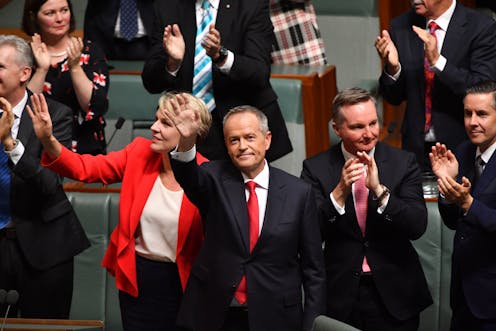
Bill Shorten’s 2019 budget reply speech has actually been years in the making.
Labor began to develop its economic policy arguments before the 2016 election campaign. Importantly, it aimed to reframe the conception of good economic management, so that it centred around producing fair and equitable outcomes.
Labor depicted itself as the party that would make the economy work for everyone, since even business would benefit from consumers having more money to spend. However, unlike the Liberals, Labor would stand up for ordinary working and middle class Australians against the big end of town.
Shorten’s budget reply speech reaffirmed those central messages, while painting a “big picture” (to use a Keating phrase) of the better future that Labor aimed to create if elected.
Admittedly, Labor’s argument about inequality was even easier to pitch when Scott Morrison, as Treasurer, argued that massive tax cuts for big business were urgently needed while delaying tax cuts to ordinary Australians. Since that time, a panicking Coalition government, facing consistently poor polls, has backed off on the big business tax cuts and brought forward tax cuts for lower and middle income Australians, as Labor had long advocated.
Nonetheless, Shorten still mounted a case that the government’s budget was unfair and inequitable. He argued that the Coalition’s projected tax rates would undermine Australia’s progressive tax system in the longer term, with a nurse ending up paying the same rate of tax as a surgeon. He added that the government’s proposed more immediate tax cuts do not give enough to people earning under $40,000 a year, many of whom were women.
Indeed, prior to his reply speech, Shorten reminded voters of the Coalition’s “woman problem” by branding the government’s tax proposals as “a Liberal party tax on working mums”. Here, as elsewhere, Shorten’s speech depicted Labor as the party that supported greater equality, including gender equality.
Read more: Shorten's budget reply will outbid government on tax relief for low income earners
He also pointed out that the government’s budget had not reversed previous cuts to schools, TAFE, apprenticeships or hospitals, and had partly brought the budget back into a projected surplus by under-spending on the NDIS. By contrast, Labor planned to significantly expand expenditure in all these areas.
Shorten placed a particular focus on increasing expenditure on education and health. He offered substantial increases to spending on preschool education, universities, TAFE, and apprenticeships.
While focusing on fairness and equality, Shorten also aimed to defuse longstanding Coalition arguments that branded Labor as the party of “debt and deficits”. He argued that Labor had made the hard decisions necessary to ensure an adequate revenue base to fund its range of initiatives, making potentially unpopular decisions in areas from franking dividends to negative gearing and capital gains tax.
Once again, these were justified on the basis of equity and fairness – Shorten argued, for example, that under the Coalition, more money would be spent on tax concessions for franked dividends than on public schools.
Read more: Shorten promises $2.3 billion package to relieve costs for cancer patients
Shorten’s pitch was therefore firmly to lower and middle income Australians. However, there were also some sweeteners to business, such as tax cuts for small and medium businesses and tax write-offs for business investments in equipment.
Indeed, unlike during the 2016 election campaign, Shorten has tried to court some sections of business while criticising others, such as the banks. However, Labor’s support for a “living wage”, restoring penalty rates and strengthening workers’ bargaining ability may require a difficult balancing act between the demands of the unions and business.
Overall, Shorten tried to counter his relatively poor public image by depicting himself as a caring and compassionate leader who aimed to build a better future for all Australians. He spoke passionately of the difference that better funding would make for those with disabilities, as well as the difference that Labor’s A$2.3 billion Medicare cancer plan would make for patients and their families.
He also made a particular pitch to younger Australians, arguing that Labor’s changes to negative gearing policy would make it easier for them to buy their own homes, while Labor’s climate change policies would generate new jobs and hand a better Australia to the next generations.
As I’ve argued in a recent book, Labor’s pitch on fairness and equality has a larger historical significance. It is a social democratic strategy designed for a period of rising economic inequality and poor wages growth, both nationally and internationally. Consequently, Labor now has much less faith in the ability of markets to produce equitable economic outcomes than it did during the Hawke and Keating years.
But I also argue that if it wins office, Labor faces major economic challenges that will impact on its ability to create a more equal and fairer society. These include the immediate economic risks identified in the budget papers, which Shorten claims Labor would counter by producing bigger surpluses than the Liberals.
They also include some more fundamental challenges. These relate to technological disruption and increasing competition from rising Asian economies.
Shorten’s speech suggests he believes Labor’s focus on education and training will play a major role in meeting such challenges. But as machines become smarter, as even skilled work is outsourced to lower wage countries, and as our competitors also focus on educating their own workforces, this may no longer be the case.
Labor governments from Whitlam to Rudd have tended to be elected in difficult economic times. How a Shorten government would weather such challenges, if elected, remains to be seen.
Nonetheless, at a time when social democracy in Europe is in electoral crisis, Australian Labor hopes to join its Antipodean sister party, New Zealand Labour, in showing a way forward for the centre left.
Authors: Carol Johnson, Adjunct Professor, Department of Politics and International Relations, University of Adelaide
Read more http://theconversation.com/shorten-uses-budget-reply-speech-to-reframe-the-economic-debate-114607


 Hashtag.net.au
