

Indigenous Australians always come off worst in disasters. This needs to stop
- Written by Bhiamie Williamson, Research Fellow in Disaster Resilience, Monash University
Indigenous communities are often the worst hit when major disasters strike. The recent floods across the Northern Territory are a case in point.
Last week, residents in the regional centre of Katherine were either evacuated or sought shelter at relief centres after the worst flooding in 28 years. Meanwhile, the remote Indigenous communities of Wugularr, Jilkminggan, Daly River and Palumpa were evacuated to Darwin. But the support provided to Indigenous communities appears to be different to that available to non-Indigenous residents.
The Northern Land Council has described how remote communities were left behind in the disaster response. And the North Australian Aboriginal Justice Agency has criticised the federal and NT governments for providing unequal support to Aboriginal people affected by the floods.
Today is Close the Gap day, a way for Indigenous Australians to remind governments of the commitments they’ve made to address racism and improve living standards. This must include addressing the inequitable treatment of Indigenous communities in times of disaster.
A widening gap
Tragically, many Indigenous peoples have come to expect discriminatory government responses in the wake of natural disasters. This reality is now widely recognised, with research spotlighting authorities’ inappropriate planning and unsuitable interventions during crises.
Indigenous peoples are over-represented in disaster-prone regions and towns. On average, nearly 15% of residents in impacted local government areas are Aboriginal and Torres Strait Islander peoples. This is despite the fact Indigenous peoples make up just 3.8% of the Australian population.
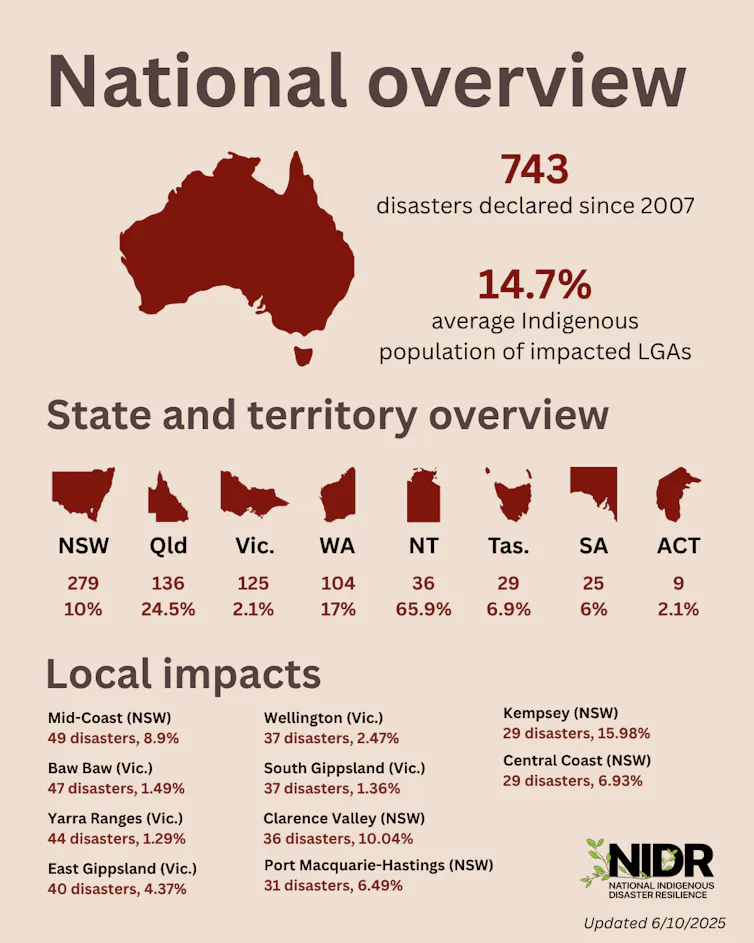
The reality of racism means Indigenous communities are often left out, or even left behind, in emergency response. The failed evacuation of Borroloola in 2024, where Indigenous residents were told to go to the local airport to be evacuated only for the plane to not come, is just one example.
This is why the National Agreement on Closing the Gap has a specific clause, Clause 64, which requires local, state and federal governments to engage with Indigenous communities before, during and after disasters.
In our recent analysis, we examined whether governments are on track to meet those commitments. Specifically, we compared the commitments governments made with the practical actions they took.
Worryingly, our findings suggest all Australian governments are failing to close the gap in emergency preparedness. Worse still, there is almost no evidence emergency management agencies are actively working to meet their commitments outlined in the National Agreement.
As Australia braces for more extreme, climate-driven disasters, this gap in emergency support will only get bigger.
Money matters
Recovering from a disaster can be very expensive. And we are failing to support the financial needs of Indigenous communities impacted by major disasters.
We found the structure of most emergency relief payments means Indigenous people usually receive less financial support than non-Indigenous people. Currently, infants and children receive lower payments than adults. Given one in three Indigenous people are younger than 15 years old, this puts the broader Indigenous population at an economic disadvantage, right when they need the most support.
We also analysed how the Australian government distributed its largest disaster management program, the Disaster Ready Fund. This fund was created after the Bushfire Royal Commission in recognition that Australia must put more resources into disaster preparedness. This is because investing in communities before disasters strike reduces recovery costs.
However, out of the nearly A$800 million pledged to strengthen the nation’s disaster resilience, only A$22 million went to Indigenous organisations. That represents only 2.2% of the total fund. And our analysis reveals no Indigenous organisations in any of the regions impacted by the most recent northern Australian floods received funding through the Disaster Ready Fund.
So, where to from here?
The National Agreement on Closing the Gap has already given governments a framework to better support disaster-prone Indigenous communities.
But to hold them to account, Indigenous researchers, organisations and policy leaders have authored the first Indigenous-led review of the National Agreement. This review argues that when governments work collaboratively with Indigenous communities during disasters and pandemics, they achieve positive results.
The Australian Institute for Disaster Resilience’s evacuation guide for Indigenous communities also provides advice to support Indigenous communities during major emergencies.
When governments work respectfully and collaboratively with Indigenous communities positive change can, and often does, follow. So what does this look like in practice? Here are three suggestions.
- building formal partnerships with Indigenous organisations and actively involving them in decision-making processes
- committing $20 million of the Disaster Ready Fund each year to Indigenous organisations to strengthen resilience in remote communities
- requiring all emergency management agencies to report progress towards Clause 64 of the National Agreement to Close the Gap.
As Australians, we know all too well how destructive major disasters can be. And it is clear they have distinct and significant impacts on Indigenous communities. So it’s time the government prioritises their safety, before the next disaster hits.
Authors: Bhiamie Williamson, Research Fellow in Disaster Resilience, Monash University


 Hashtag.net.au
