

Most people with disabling mental health conditions can’t access the NDIS. Here’s a better way to provide support
- Written by Sam Bennett, Disability Program Director, Grattan Institute
The pathway to reforming the National Disability Insurance Scheme (NDIS) is littered with obstacles.
Among the biggest challenges is the federal and state governments agreeing on responsibility and funding for “foundational supports”. These are disability-specific services for people who don’t qualify for individual NDIS funding.
There has been some progress on foundational supports for children with developmental delay and autism. The federal government’s Thriving Kids initiative is due to begin mid-2026.
But there has been no progress on non-NDIS foundational supports for people with “psychosocial disability”. This is disability that can result from mental health conditions such as schizophrenia, major depression or post-traumatic stress disorder, affecting the person’s ability to function.
Our new Grattan Institute report shows how Australia can build a national system of psychosocial supports within five years without spending any more money. This will require a clear vision, smart design choices and strong commitment from all governments.
What does psychosocial support look like?
Psychosocial supports are non-clinical supports that help people with mental health challenges live meaningful, independent lives in the community.
They include programs that help people to build social connections, learn skills, or maintain stable housing.
The personal, social and economic costs of not getting this support are significant – including reduced quality of life, fewer opportunities for community participation and lost productivity.
What’s the problem?
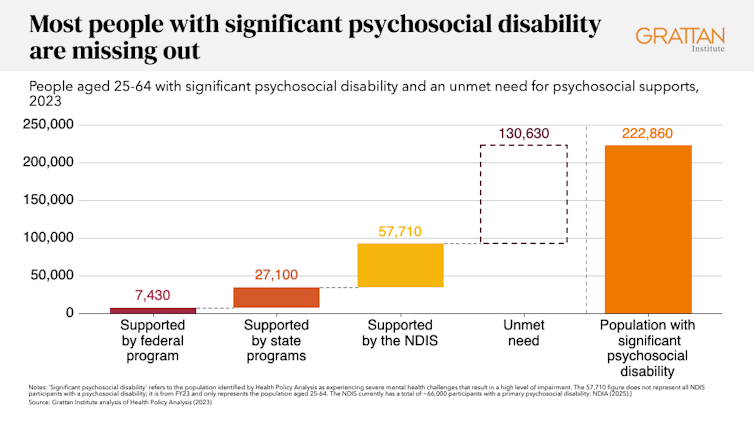
Almost 223,000 Australians aged 25–64 had a significant psychosocial disability in 2023.
Of those, almost 58,000 received psychosocial supports from the NDIS, with the scheme providing more than A$5.8 billion to support this group in the past year.
However a majority of people with significant psychosocial disability are below the NDIS eligibility threshold. And around 130,000 adults receive no support.
Access to non-NDIS supports is patchy
Federal, state and territory governments all fund small psychosocial support programs through their mental health systems. These are outside the NDIS.
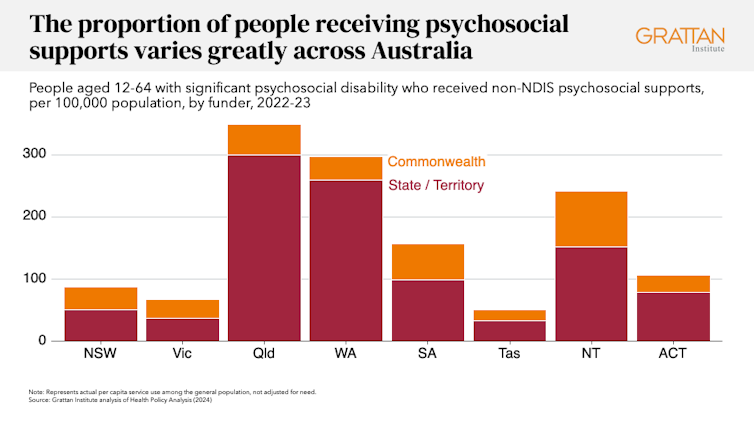
Coverage is insufficient in all states and territories. The extent of support available depends far more on where you live than on your level of need.
Our analysis shows this variation is dramatic. There is a seven-fold difference in the proportion of people who receive psychosocial support outside the NDIS between Queensland (the highest) and Tasmania (the lowest).
There are also huge differences in the intensity of services offered. Queensland, for example, provides small amounts of support to relatively high numbers. In New South Wales, services reach very few people but provide more than ten times the number of hours per person.
Authors: Sam Bennett, Disability Program Director, Grattan Institute


 Hashtag.net.au
