

Why Every Mining Site Needs a Purpose-Built First Aid Kit
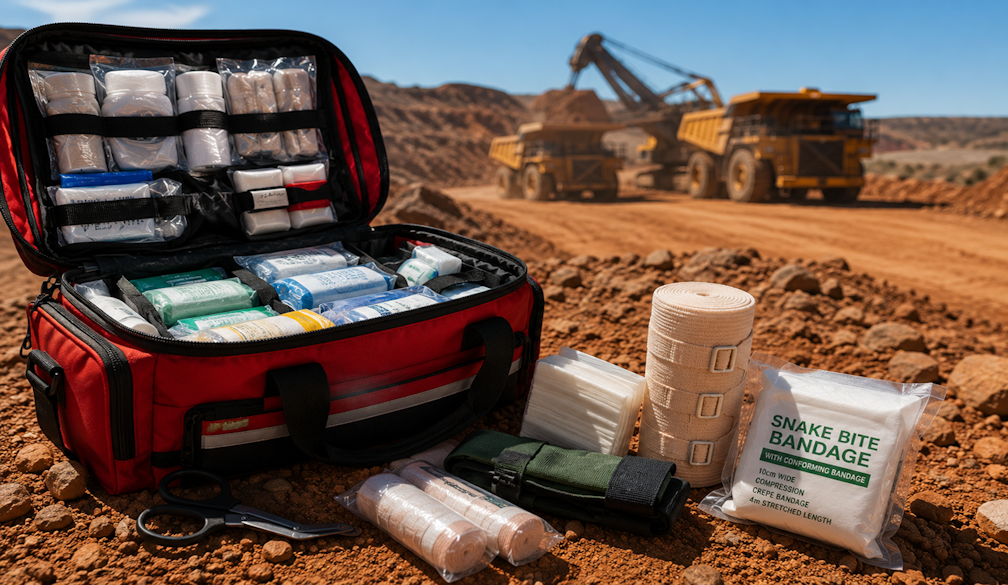
Mining is one of the most physically demanding industries in Australia, and it's also one of the most heavily regulated when it comes to worker safety. A single incident on a remote site can take twenty minutes or more before emergency services arrive, which means the difference between a manageable injury and a serious outcome often comes down to what's sitting in the first aid cabinet. A properly stocked mining first aid kit isn't a compliance box to tick; it's frontline equipment that safety officers rely on every single shift.
Across Western Australia, Queensland, and the Northern Territory, mining operations face a unique combination of risks: heavy machinery, extreme heat, dust exposure, chemical handling, and isolation from hospitals. These conditions demand a first aid response that goes well beyond a standard workplace kit. This article looks at what makes mining first aid provisioning different, the regulatory landscape that shapes it, and how sites can build a response capability that actually holds up when it's needed.
What Sets Mining Sites Apart from Other Workplaces
Most workplace first aid kits are designed around minor cuts, sprains, and the occasional headache. Mining sites deal with a different category of injury entirely. Crush injuries from heavy plant, burns from welding and hot surfaces, eye trauma from flying debris, and heat-related illness are all realistic scenarios on any given shift.
The remoteness factor compounds every one of these risks. A worker injured on a metropolitan construction site might have paramedics on scene within ten minutes. A worker on a Pilbara iron ore operation could be two hours from the nearest hospital by road, and even further by air if weather grounds a helicopter. This is why safety managers in the sector typically build a first aid kit for the mining industry around trauma stabilisation rather than minor injury management. The goal is to keep an injured worker stable and comfortable until higher-level care arrives, not just to patch them up.
Core Contents of an Effective Mining Kit
A genuinely fit-for-purpose kit reflects the real injury profile of the site. At minimum, most mining safety teams will include:
- Trauma dressings and compression bandages for significant lacerations and crush injuries
- Burns dressings and cooling gel, given the prevalence of hot surfaces and equipment
- Eye wash stations and irrigation solution for dust and chemical exposure
- Splinting equipment for suspected fractures
- Tourniquets and haemostatic dressings for severe bleeding control
- Resuscitation masks and CPR equipment
- Snake bite bandages, particularly relevant for sites in northern and remote regions
- Electrolyte replacement and heat stress management supplies
The exact mix depends heavily on the site's specific hazard profile. An underground coal operation has different priorities to an open-cut iron ore mine, and a site with a permanent camp will need different resupply logistics to a fly-in fly-out operation. This is where it pays to work with a supplier who understands mining rather than a generic medical wholesaler, one who can tailor a mining first aid kit to the actual risk assessment for that particular site, rather than offering a one-size-fits-all box.
Regulatory Requirements and Compliance
Under the Work Health and Safety Act and the associated Mines Safety regulations in states like Western Australia and Queensland, mine operators carry a legal duty to provide first aid facilities that are proportionate to the number of workers, the nature of the work, and the distance from medical facilities. This isn't a vague guideline; regulators expect documented risk assessments that justify the specific first aid provisioning on site, and inspectors will check kit contents against those assessments during audits.
Compliance also extends to who is administering care. Larger sites typically require a minimum number of accredited first aiders per shift, often with additional qualifications in remote area first aid or advanced resuscitation. Kits need to match the skill level of the people using them; there's little value in stocking advanced trauma equipment if nobody on shift is trained to use it correctly.
Documentation matters just as much as the physical contents. Safety officers should maintain a register showing when kits were last checked, what was restocked, and any incidents where supplies were used. This record becomes essential during regulatory audits and can also flag patterns; for example, if a particular type of injury is recurring, it might point to a broader hazard that needs addressing at the source rather than just being treated after the fact.
Remote Location Challenges
Distance from town is the defining logistical challenge for mining first aid provisioning. Supplies degrade over time, particularly in the heat and dust common to inland and northern mining regions. Adhesive dressings lose their stick, medications pass their use-by date faster than expected in extreme temperatures, and packaging can deteriorate in humid coastal or tropical sites.
This means resupply planning needs to account for lead times that would be unthinkable in a city office. A metropolitan business might reorder supplies with next-day delivery in mind. A remote mining camp might need to plan stock levels around a monthly or even quarterly resupply cycle, factoring in wet season road closures or limited freight schedules. Sites that get caught short typically do so because they've applied urban assumptions to a genuinely remote operation.
Smart safety teams build in buffer stock and stagger their check dates so that not every kit expires at the same time. They also train multiple people across different shifts to manage restocking, so the responsibility doesn't sit with a single person who might be on leave or transferred when a gap needs filling.
Training and Competency
Equipment alone doesn't save lives; the person using it does. Mining companies typically invest in a tiered training structure: basic first aid for the general workforce, advanced first aid or remote area first aid for designated site first aiders, and specialised training for supervisors who need to manage a serious incident response and liaise with the Royal Flying Doctor Service or emergency retrieval teams.
Refresher training is non-negotiable in this environment. Skills like CPR and wound packing degrade quickly if they're not practised, and the stress of a genuine emergency on an isolated site is very different to a calm classroom scenario. Many operations now run scenario-based drills that simulate realistic incidents a vehicle rollover, a fall from height, a chemical splash so that first aiders build muscle memory rather than just theoretical knowledge.
It's also worth noting that competency requirements can vary by state and by the specific type of mining operation, so safety managers need to stay current with the relevant WHS regulator's guidance rather than assuming a national standard applies uniformly.
Building a Site-Specific Risk Assessment
The starting point for any mining first aid strategy should always be a proper risk assessment, not a supplier's default product list. This means walking the site, reviewing the past twelve months of incident reports, and talking to the people actually doing the work about near-misses that never made it into a formal report.
From there, safety officers can map likely injury types against current kit contents and identify gaps. It's common to find that a site has plenty of supplies for minor cuts and abrasions but is under-equipped for the serious trauma scenarios that are statistically more likely given the machinery and conditions on site. Reviewing this guide to mining medical supplies alongside an internal risk assessment can help pressure-test whether current provisioning actually matches the real hazard profile, rather than just historical habit.
Getting the Balance Right
There's a temptation on some sites to over-provision with every conceivable item, which creates its own problems: bulky kits that are hard to carry to an incident, expired stock that nobody notices because there's too much of it, and a false sense of security that more equipment automatically means better care. The better approach is a lean, well-organised kit matched precisely to the site's actual risk profile, backed by clear labelling, regular audits, and a trained team who know exactly where everything is without having to search.
Fly-In Fly-Out Sites and Rotational Workforces
Rotational workforces add a layer of complexity that permanent-crew sites don't have to manage. Workers on two-week-on, two-week-off rosters mean that the people responsible for checking and restocking kits are constantly changing, and continuity can slip through the cracks if handover procedures aren't tight. A first aider who identifies a gap in supplies on day twelve of their swing might not have time to action it before they fly out, and the incoming crew may not know a restock was already flagged.
Sites that manage this well typically build first aid checks into their shift handover documentation, the same way they'd hand over plant maintenance issues or safety observations. This ensures continuity isn't dependent on any one individual remembering to follow up. It's also worth having redundancy in trained first aiders across every roster combination, rather than relying on one or two people who happen to be rostered together; a serious incident doesn't wait for the right combination of people to be on site.
Camp accommodation areas need their own first aid consideration too, separate from the operational work areas. Injuries and illness don't stop when a shift ends, and a worker who becomes unwell overnight in camp needs the same level of preparedness as someone injured on the pit floor during the day. This often means smaller, more accessible kits distributed through accommodation blocks in addition to the primary medical response capability near the active work areas.
Working With Site Medical Teams
Larger mining operations, particularly those with hundreds of workers on remote sites, often have a dedicated site medic or nursing presence rather than relying solely on first-aid-trained general staff. In these environments, first aid kit provisioning needs to align closely with what the site medical team actually wants on hand, rather than being decided independently by procurement or safety administration.
This collaborative approach tends to produce better outcomes than a purely compliance-driven checklist. Site medics can advise on which specific brands or configurations of trauma equipment they're most confident using under pressure, flag items that look good on paper but rarely get used effectively in the field, and identify gaps based on the actual incident history they've been managing. Regular check-ins between safety management and site medical staff, ideally quarterly rather than only after an incident, help keep provisioning aligned with real operational experience rather than becoming a static, unreviewed list.
Final Thoughts
A mining first aid kit is only as good as the thinking behind it. Regulatory compliance provides the floor, but genuinely effective provisioning comes from understanding the specific hazards of a site, the realistic response times available, and the training level of the people who'll be reaching for that kit in a crisis. Getting this right isn't just about meeting an audit checklist; it's about giving workers in one of Australia's toughest industries the confidence that if something goes wrong, the response on hand will actually make a difference.

 Hashtag.net.au


